


Noion is a brand new record label founded by Paul Haslinger (Tangerine Dream, Lightwave) and Christian Wittman (Lightwave). The label aims to redefine ‘listening with atmospheric minimalism, sound exploration, and genre-defying music – from ambient to contemporary classical and drone.’
To put that statement into practice, they’re releasing two albums with their own music. The albums are inspired by two influential writers from the 19th and 20th centuries: Stéphane Mallarmé and Jorge Luis Borges.
“One of the most influential writers of the 20th century, Jorge Luis Borges was an Argentine short-story writer, essayist, poet and translator regarded as a key figure in Spanish-language and international literature. Renowned for his profound and poetic explorations of reality, time, and the nature of language, his works often delve into philosophical puzzles, blending fiction with metaphysical inquiries, and have had a major influence on the magical realist movement in 20th century Latin American literature.”
I must admit I am not familiar with Borges’ work. Perhaps I should be … and the music on the album definitely is a great invitation to do so.
The six tracks – ranging from 5 to 9 minutes, explore Borges’ ‘themes of illusion, memory, fiction, and the infinite […] The music ‘mirrors the complexity of his literary universe.With its subliminal lines and expansive atmospheric textures, the music unfolds like a labyrinth – layered, intricate, and filled with subtle events.
The music on this album is – indeed – genre-defying. It is ambient, cinematic, electro-acoustic, but it also has contemporary-classical influences. It is not strictly ‘electronic’ also ‘acoustic’ music.
From the liner notes I learn that Stéphane Mallarmé’s 1897 poem ‘Un coup de dés jamais n’abolira le hasard’ (A throw of the dice will never abolish chance) was radical in its use of free verse and unusual typographic layout.
Haslinger and Wittman ‘capture the random, abstract essence of his text through an immersive, unhurried pace, where sounds and motifs reverberate in recurring patterns. We embraced a minimalist simplicity to better isolate sonic and harmonic elements – much like Mallarmé visually separates words or clusters of words, treating them as distinct sonic, visual, and semantic entities.’
A noticeable difference to the music on Borges is the length of the tracks. The tracks are much longer, from 17 to 20 minutes, and the instrumentation is somewhat more abstract.
“Interweaving minimalism and experimentation, impressionism and abstraction, the work invites the listener into a realm of tonal poetry.”
Illiterate as I am, I must admit (again! Shame on me!!) that I don’t know the work of the French poet Stéphane Mallarmé. So I cannot judge the way the music represents the spirit of the work of there writers like someone who is familiar with their work.
It probably helps to extra appreciate these albums. But I myself am living proof that it is nót necessary to know their work to thoroughly enjoy this music.
Borges and Mallermé are two very impressive albums to start a new label with. As a label, Noion wants to ‘evolve into a platform for like-minded musicians, creating a space to explore new creative territories at the intersection of contemporary music, minimalism, ambient, and classical traditions.’
Based on this label kickoff, I’m sure that this will not be the last time releases from this label will be recommended here on Ambientblog.

"The founding of noion Music is not merely the launch of a new label; it stands as an act of creative independence against an industry dominated by algorithms and functional “background music.” This project is the culmination of a forty-year creative relationship between Paul Haslinger (former Tangerine Dream member) and Christian Wittman (Lightwave), rooted in a mutual respect dating back to 1986. Together, they define their genre not as traditional composition, but as an exploration of Atmospheric Minimalism—searching for the sonic quintessence where silence is as vital as the note itself.
Conceptually, Haslinger treats music as a curated soundscape, a field of meditative experience that invites deep, mindful listening. The premise relies on Haslinger’s view of intellectual life as a palace of memory full of books, where literature serves as a compass for Electronic exploration. With “Mallarmé,” alongside the projected “Borges” project, this is the inauguration of that journey—a space where mathematical precision meets metaphysical depth. Released on July 10, 2026, “Mallarmé” features three massive tracks hovering around the twenty-minute mark, culminating in an edited version of “Jamais n’abolira.”
The album’s core is Stéphane Mallarmé’s seminal 1897 poem, “Un coup de dés jamais n’abolira le hasard” (A throw of the dice will never abolish chance). Wittman and Haslinger have translated the fragmented typography and visual silences of the page into a fluid sonic environment. Central to the album’s development is Wittman’s use of surrealist automatic writing to generate unconscious creative flows, which Haslinger then refines and sculpts technically. The objective was to capture the abstract essence of the text through a calm rhythm and recurring motifs, creating a geography where the intellect maps the sound.
The album unfolds through three primary movements that explore temporal elasticity and the perception of sound, effectively turning the listening experience into an active intellectual pursuit. The monumental opening, “Un coup de dés,” establishes the spatial parameters of the record. It serves as a game of mirrors and sonic ricochets, evoking the successive throwing of dice cited by Wittman to trigger unpredictable harmonic events. Here, the use of advanced virtual synthesizers and complex spatialization processes creates a sense of impressionistic abstraction. Motifs appear and vanish cyclically, challenging the predictability of traditional listening habits while establishing a vast acoustic gravity.
The focus shifts toward reductionism to reveal the work’s essence in “Jamais n’abolira.” This movement embodies the minimalist simplicity required to isolate harmonic clusters, mirroring how Mallarmé visually separated words across the page. Wittman and Haslinger have treated every harmonic element as an isolated word on a blank page, giving each sound a distinct semantic entity. Through a calm rhythm and imperturbable tempo, the track strips away the superfluous to reach maximum clarity and impact—an exercise in free association transporting the listener to a realm of pure tonal poetry.
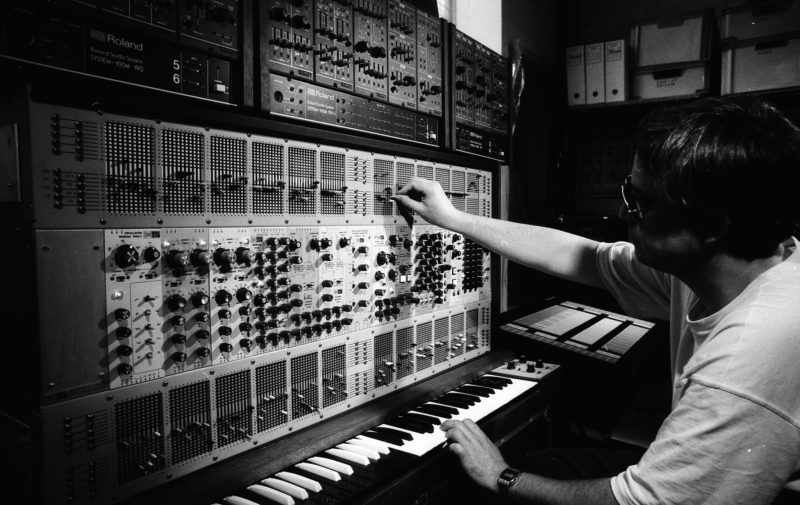
“Le hasard” is the chapter dedicated to Chaos explores the fragmentation of structural predictability. The composition alternates between continuity and rupture, creating an experience of impressionistic abstraction. Characterized by sonic ricochet effects and a continuous interplay between flow and interruption, the structure reflects a multidimensional perception. Electronic modular systems (utilizing both the ARP 2600 and virtual MAX systems) generate evolving forms and timbral colors along an elastic temporal continuum. This is not a closure of discourse, but an open reflection on the fugitive nature of acoustic perception.
The album concludes with, “Jamais n’abolira – edit,” a condensed iteration of the second movement. Running just over six minutes, this version offers a more synthesized approach to the track’s core motifs, providing a focused entry point into its architecture. “Mallarmé” is the result of a poetic dialogue between the Nina Studio in Paris and Large Array in Los Angeles, overcoming geographical distances through technological integration. It is a necessary sanctuary of clarity, silence, and space amidst the noise of the 21st century.
This is not merely a technical exercise but a “mode of being” through sound. The production process itself—based on a continuous exchange of files and stems between the two studios—was treated by Haslinger not just as a mixing stage, but as a microscopic orchestration. Every detail was sculpted to alter the relationship between sound and space, inviting the listener to a mindful state that defies the current industry’s noise culture.
As the artists declare, this is only the beginning: noion will serve as a platform for like-minded musicians, with the Count of Lautréamont as the next literary territory to be explored. For those willing to undertake this meditative journey, “Mallarmé” is available from July 10, 2026."
Jacopo Vigezzi

"There is a lot of unresolved tension throughout the two releases inaugurating their Noion Music label. From start to finish
Filling a listening space with music as fluid occupies a vessel, or smoke might circulate through a room, every new moment of
Musical lines
Please tune in to the 07.19.26 broadcast of
Chuck van Zyl

Greg Fenton reviews Paul Haslinger and Christian Wittman – Mallarmé – noion Music
Four expansive pieces of music inspired by Mallarmé’s Un coup de dés jamais n’abolira le hasard are brought together in this artistic collaboration, which feels revelatory and invites the listener into a bold, deeply immersive musical world. The enduring power of the verse is signalled by the cover shot of Stéphane Mallarmé, whose stare, infused with purposeful meaning, dates from 1890. And while the impulse may have originated then, this album is filled with robust, modern discourse.
Apart from stating the obvious that musically the sounds used to form the compositions radiate as much contemporary energy as they gently echo the past, there is something transformative as you are transported into a whirlwind of emotions, sensory lifts and falls, amid a wild, exulted variety of imaginary memory. Given the passages are lengthy, tone and atmosphere are given free rein to expand and shift at will, which only heightens anticipation of change and its host of invigorating complexities. It is quite amazing to witness the physical shift as pieces of music move from melancholy to the more sublime, pausing at all points far and wide, very much like a deep investigation in motion, with emotionally persuasive ideas captured in the formation of sounds.
At times, the piano becomes the emotional centrepiece, almost singing; elsewhere, hot-wired electronics take over, driven by a radical interpretation of their consequences in a mixed-up world, or through evocative swells of synthesiser pads and strokes of modular sequencing. Throughout, it’s the extraordinary depth of communication—the constant interplay of light and dark—that makes this recording so compelling. Quite exceptional.

We are confronted with sketches, with explorations of acoustic relationships and sound processing that could be perceived as a minimal anamorphosis of musique concrète. These suspended works evoke less external landscapes than inner introspections, cinematic atmospheres, spaces of emotion, and intimate resonance.
Christian Wittman and Paul Haslinger have a complete mastery of this territory, where listening becomes a sensitive and immersive experience.
One is reminded of On Land by Brian Eno, though without its organic quality. A musical abstraction that is nevertheless not deconstructed, best experienced in semi-darkness, allowing the listener to perceive its smallest interstices."
Thierry Moreau (Design, Digital creation)


This album Sur incises – Messagesquisse – Anthèmes 2, featuring Jean-Guihen Queyras, Hae-Sun Kang, and the Ensemble intercontemporain, is a remarkable showcase of Pierre Boulez’s visionary approach to contemporary music. Spanning three distinct works, the album highlights Boulez’s unparalleled command of rhythm, timbre, and structural innovation.
Sur incises, a reimagining of Boulez’s earlier Incises, unfolds a dazzling sonic architecture for three pianos, three harps, and three percussionists, combining precision with radiant color. Jean-Guihen Queyras’s cello contributions add a remarkable depth, perfectly blending with the Ensemble intercontemporain’s intricate textures.
Messagesquisse, written in 1976, offers a subtler, introspective side of Boulez, exploring delicate interplay between instruments and nuanced harmonic shifts. The Ensemble’s interpretation brings out every subtle contour of this intimate chamber work.
Finally, Anthèmes 2, composed for violin and electronics, demonstrates Boulez’s late-career fascination with spatialization and live sound transformation. Hae-Sun Kang delivers a virtuoso performance, responding to the electronic textures with astonishing sensitivity and precision.
Together, these works reveal Boulez’s extraordinary ability to merge intellectual rigor with sensuous sonic beauty. This album stands as a testament to his enduring influence on contemporary music, offering listeners a rare and deeply immersive encounter with one of the 20th century’s most innovative composers.

Review by Alan Freeman, Audion 86, February 2026, p. 32.

Review of "The Northwest Passage" by Ly Luan in HOUZ-MOTIK MAGAZINE

By mapping the void, modern Europe convinced itself that a maritime corridor lay dormant somewhere beneath the Arctic ice. The Northwest Passage was born of a geographical assumption that became a political obsession. Behind the legend were figures embarking on a journey that did not yet exist, and often toward their own demise. a chronicle of a record that scrutinizes the margins of the world rather than its myth.
Christian Wittman explores the myth of the Northwest Passage without heroism or folklore. In The Northwest Passage, he sculpts a soundscape of drones, creaks, and mists, where the Arctic becomes less a setting than a space of uncertainty. This is not an expedition narrative, but rather an inner drift, attentive to silences and discreet phenomena. The ambient album questions what remains when bodies disappear, transforming ice into something to be listened to rather than a spectacular image...

What strikes us immediately is the restraint. Wittman does not dramatize anything; he stretches out the space, lets the air circulate, and creates an unstable horizon where landmarks dissolve. The historical explorers, those who, from Hudson to Franklin, attempted to open a route between the Atlantic and the Pacific, never appear explicitly. The album simply inhabits their absence. We perceive fragments, auditory silhouettes, movements of dark masses; never heroic gestures, nothing commemorative. The tribute is conveyed through the material, not through narration.
Textures: coldness as architecture. The compositions are based on meticulous layering, subterranean drones, rustling sounds worked like sediments, abrasive layers that crack and then fall silent. Here, the sea is anything but flat. It breathes, swells, recedes; it acts as a discreet engine that supports each sequence. The creaking of icebergs seems to emerge from an intermediate space—neither documentary nor fictional—and it is this ambiguity that gives the record its density. The result clearly evokes a work of synthesis and sound design that seeks to reproduce physical phenomena rather than illustrate a polar postcard.
“It is not the Arctic that is inhospitable, but our ignorance of how to live in it.” – Vilhjalmur Stefansson (The Friendly Arctic (1921)

Inner journey vs. icy odyssey
The real movement of the album lies in its breathing. The pieces open like corridors of mist, tighten, fragment, then let the diffuse light back in. This is not a chronological narrative. We drift along, as if each track were questioning a state, a wait, a disorientation, an asceticism, without ever seeking resolution. The cold acts here as a functional metaphor: it strips away, reduces gestures, slows down thought. We find ourselves listening to the silences more than the sounds, as if the material were deliberately disappearing to allow vertigo to emerge.
The Arctic, not as a setting but as an interval. The last third of the album is the most compelling: Wittman achieves a sobriety reminiscent of certain minimalist works where a single movement is enough to maintain tension. The Arctic is not treated as a sublime spectacle, but as a zone of indeterminacy. It brings to mind the lines of old maps, the hesitant tracings, the errors of judgment that made the world seem bigger than it was. Far from the routes that were once sought to be forced through the ice floes, this album reminds us that there are still passages that can only be opened by paying attention. Here, the crossing is not geographical: it takes place in the fragile interval between what resonates and what fades away.
Fantastic review of "The Northwest Passage' in the webzine Houz-Motic by Ly Luan

Christian Wittman explore le mythe du Passage du Nord-Ouest sans héroïsme ni folklore. Dans The Northwest Passage, il sculpte un paysage sonore fait de drones, de craquements et de brumes, où l’Arctique devient moins un décor qu’un espace d’incertitude. Pas de récit d’expédition, plutôt une dérive intérieure, attentive aux silences et aux phénomènes discrets. Le disque ambient interroge ce qui subsiste quand les corps disparaissent, et transforme la glace en matière d’écoute plutôt qu’en image spectaculaire…
Ce qui frappe d’emblée, c’est la retenue. Wittman ne dramatise rien, il étire l’espace, laisse l’air circuler, installe un horizon instable où les repères se dissolvent. Les explorateurs historiques, ceux qui, de Hudson à Franklin, ont tenté d’ouvrir une route entre Atlantique et Pacifique, n’apparaissent jamais explicitement. Le disque se contente d’habiter leur absence. On perçoit des fragments, des silhouettes auditives, des mouvements de masse sombre ; jamais de gestes héroïques, rien de commémoratif. L’hommage passe par la matière, pas par la narration.
Textures : le froid comme architecture. Les compositions reposent sur un travail de couches minutieuses, drones souterrains, bruissements travaillés comme des sédiments, nappes abrasives qui se fissurent puis se taisent. Ici, la mer n’a rien d’aplatissant. Elle respire, gonfle, recule ; elle agit comme un moteur discret qui soutient chaque séquence. Les craquements d’icebergs semblent surgir d’un espace intermédiaire – ni documentaire, ni fictionnel – et c’est cette ambiguïté qui donne au disque sa densité. Le rendu évoque nettement un travail de synthèse et de design sonore cherchant à reproduire des phénomènes physiques plutôt qu’à illustrer une carte postale polaire.
« It is not the Arctic that is inhospitable, but our ignorance of how to live in it.” – Vilhjalmur Stefansson (The Friendly Arctic (1921)
Le véritable mouvement du disque se trouve dans sa respiration. Les pièces s’ouvrent comme des couloirs de brume, se resserrent, se fragmentent, puis laissent de nouveau entrer la lumière diffuse. On n’est pas dans un récit chronologique. On avance par dérive, comme si chaque piste interrogeait un état, attente, désorientation, ascèse, sans jamais chercher la résolution. Le froid agit ici comme une métaphore fonctionnelle : il dépouille, réduit les gestes, ralentit la pensée. On se surprend à écouter les silences plus que les sons, comme si la matière disparaissait volontairement pour laisser émerger le vertige.
• À lire aussi sur Houz-Motik : une exploration sonore signée Andrew Heath et Christian Wittman
L’Arctique, non comme décor mais comme intervalle. Le dernier tiers du disque est le plus convaincant : Wittman y atteint une sobriété qui rappelle certains travaux minimalistes où un seul mouvement suffit pour maintenir la tension. L’Arctique n’y est pas traité comme un spectacle sublime, mais comme une zone d’indétermination. On pense aux lignes de cartes anciennes, aux tracés hésitants, aux erreurs d’appréciation qui faisaient le monde plus grand qu’il n’était. Loin des routes qu’on cherchait jadis à forcer dans la banquise, ce disque rappelle qu’il existe encore des passages qui ne s’ouvrent qu’en prêtant attention. Ici, la traversée n’est pas géographique : elle se joue dans l’intervalle fragile entre ce qui résonne et ce qui s’efface.


On first listen, "Lateral" is a return to the roots: those of "Thursday Afternoon" and the other long ambient pieces accompanying Brian Eno's installations. Eight tracks, each around eight minutes long, to be listened to like a long, continuous suite, without any break. Listened to in shuffle mode, the album lends itself to hours of variations in the same sonic and immersive continuum.
The eight tracks are named “Big Empty Country I, II, III, IV etc.”, like so many movements of the same work, a nod perhaps to the musical genre of the album “Luminal”, which I'll comment on in another post, but also, perhaps, a refusal of any referential instructions, an ironic evocation of the ambient genre, furnishing music for empty rooms, or a sonic tabula rasa that the listener is invited to furnish and decorate as he or she pleases, like a blank screen on which to project inner images. ..
The album title “Lateral” is a kind of riddle, when you look at the cover: two luminous discs integrated into a square (squaring the circle?)...
The minimalist choice of a same sound color, a same instrumental palette throughout the album, enriched by infinite microvariations, also takes us back to the roots of Eno's music and of the ambient genre. Ethereal pads, diaphanous piano outlining possible melodic lines, slow waves of sound surging in loops reminiscent of the Revox magnetic tape experiments of the past...
This is a slow, immersive music, with filtered sounds, that unfolds like a long, luminous, shimmering ribbon, lending itself to a floating, enveloping listening experience. Harmonic layers with a thousand reflections, punctuated by suspended notes...
We are now in a times of profusion of tools for virtual studios, of ad nauseam declensions of sample libraries, and the algorithmic tyranny of playlists favors muzak by the mile when it isn't created by an AI that produces the lowest common denominator of musicality.
Brian Eno, remaining true to his identity and artistic vision, once again stands outside fashion, that is, outside time, with an ambient work that combines simplicity and sophistication, minimalism and harmonic architecture...
Once again, a great lesson in ambient composition, and, for me at least, the promise of a never ending musical pleasure...

I think I first heard Pink Floyd in 1971 or 1972, with Atom Heart Mother and Meddle.
And my first concert was in January 1973, at the Palais des Sports in Paris, where Pink Floyd accompanied Roland Petit's ballets: an unforgettable sensory, visual and aural experience!
The official release of the restored video and remixed album Pink Floyd at Pompeii, - MCMLXXII brings back many memories - I remember seeing the film on French public television when I was young, and I was able to buy a bootleg CD of the soundtrack.
The sound of the double CD remixed by Steven Wilson is flawless, excellent. It perfectly recreates what Pink Floyd sounded like live in the 70s.
I've never stopped listening to and loving this music. I grew up with it. It made me dream and fly in the outer (or inner?) space...
Listening to this soundtrack again, in the near-perfect version of this remix, inspires me to reflect on a few things...
Firstly, the perfect synergy of a band where everyone's talents contributed to an overall sound and feel. This is as true for the vocals - Rick Wright and David Gilmour on Echoes - as it is for the alchemy of the overall instrumental sound, lead guitar, keyboads, bass, drums.
Pink Floyd's music has always had a strong identity in the field of progressive rock... It didn't rely on the virtuosity of its instrumentalists, like Yes, for example. After their debut with Syd Barrett, they broke away from the pop song format. It embraced a certain sonic experimentation not found in Genesis or King Crimson, but rather in Tangerine Dream and Klaus Schulze (who influenced whom? The subject is still open...).
With relatively classic instrumentation (the VCS 3, if I'm not mistaken, only appeared with The Dark Side of the Moon), but boundless inventiveness, in the use of effects (delays, loops...) as well as in the sequence of climates (A Saucerful of Secrets, Echoes, One of these Days) and dramatic climaxes (Careful with that axe, Eugene), Pink Floyd invites listeners on psychedelic journeys, inspiring multiple images and sensations.
Pink Floyd at Pompeii remains astonishingly innovative and ground breaking, more than fifty years after this recording.
The instrumental sound remains magnificent, between Rick Wright's keyboards and David Gilmour's guitar.
Nick Mason brings a unique percussive swing, enhanced tenfold by his recorded loops.
The whole thing floats in an unlikely, vintage space of time, no doubt... I find that the abstract sound effects on Set the Controls for the Heart of the Sun or A saucerful of secrets remain unrivalled today - from the echo on Rick Wrigh's keyboard playing and Gilmour's guitar to the loops of Nick Mason's drums.
Limited technical resources were compensated by boundless inventiveness...
We hear musicians immersed in an unprecedented experimental trip, who have found in concert situations, with or without an audience, a unique space for expression and creative expansion...
I never tire of listening to these vintage musical trips...
Pink Floyd's music, from the 70s, tells stories, explores territories, maps out possible universes, explores the depths of our imaginations... It leads listeners to immerse themselves in sound worlds that hybridize genres - blues, rock, electro-acoustic experimentation - to generate their own images and inscribe their own memories, over the course of live performances that weave multidimensional sound with the sensory bombardment of light shows out of the ordinary since the early days...

Creatika Music.
Electronic Neoclassical New AGe World Ambient
The French duo Lightwave, composed of Christoph Harbonnier and Christian Wittman, has left an indelible mark on electronic and ambient music since its formation in 1984. Their album Cités Analogues, originally released in 1988, has been reissued on January 10, 2025 by Bureau B. This album is a masterpiece of kosmische and concrète, combining elements of analog synthesizers and location recordings to create expansive, dreamlike soundscapes.
Lightwave has explored diverse musical styles throughout his career, from his early experiments in Modular Experiments (1987) to collaborations with artists such as Hector Zazou, Michel Redolfi, and Paul Haslinger. Their focus on concrete and ambient music has led them to create works that evoke poetic and sensual worlds. The album Cités Analogues is a sonic journey that invites listeners to immerse themselves in their complex and beautiful compositions.


