I just created a Spotify playlist with the music I love, that I currently listen to and that inspires me: DEEP LISTENING...
Quiet music for hectic times...
Silence and harmonics in a noisy world...
Human creativity against the IA flood....

I summarize it below, in English.
Marion Dupont examines how music listening has evolved from a largely collective cultural practice into a highly individualized activity closely linked to emotional regulation and self-management. Although music is one of the most widespread cultural activities today—more common than reading or video gaming—it is rarely discussed in depth despite its growing influence on everyday life.
Today, music accompanies people almost constantly: when waking up, working, exercising, commuting, relaxing, or falling asleep. Thanks to smartphones, streaming platforms, and portable devices, individuals can instantly select a soundtrack that matches or shapes their mood. Statistics from the French Ministry of Culture illustrate this transformation: while only 9% of French people listened to music daily in 1973, the figure has risen to 57% today. Among young adults, music consumption is nearly universal.
The article draws heavily on the work of American sociologist and musicologist Tia DeNora, particularly her influential book Music in Everyday Life (2000). Rather than asking what music means, DeNora investigated what people do with music in their daily lives. Through interviews with middle-class women, she discovered that music serves numerous practical functions: it helps people wake up, relax, focus, prepare for social events, cope with unpleasant situations, remember the past, or process emotions such as grief.
According to DeNora, these diverse uses are based on a shared belief that music possesses transformative power. People do not simply listen to music for entertainment; they actively use it to influence their emotions, perceptions, memories, and even their identities. She therefore describes music listening as a “technology of the self,” borrowing a concept from philosopher Michel Foucault. In this sense, music becomes a tool through which individuals shape their behavior, emotions, and sense of self in order to navigate modern life.
Several scholars expanded on DeNora’s ideas. Israeli sociologist Ori Schwarz argues that music functions both as a way of designing one’s environment and of shaping one’s inner emotional life. Whether accompanying a meal, a workout, household chores, or intimate moments, music is increasingly used to create desired atmospheres and emotional states.
The article emphasizes that this transformation has been closely linked to technological developments. Before the nineteenth century, listening to music generally required either performing it oneself or attending a specific venue such as an opera house, church, or concert hall. The invention of recording technologies, including the phonograph and gramophone, allowed music to enter private homes and be replayed repeatedly. This changed the listening experience by separating music from the circumstances of its original performance.
However, music remained a largely social activity for much of the twentieth century. Records were expensive, and listening often took place in family settings or communal spaces. A major shift occurred in 1979 with the introduction of Sony’s Walkman. By allowing individuals to listen privately through headphones, the Walkman created what researcher Michael Bull called a “sonic cocoon.” Music became portable, personal, and detached from specific locations, enabling listeners to construct unique soundtracks for everyday experiences.
The transition to digital music further accelerated this trend. File-sharing platforms such as Napster, Kazaa, and eMule gave users unprecedented access to vast musical libraries, while MP3 players and Apple’s iPod made it easier to organize personalized playlists. As a result, people increasingly curated their own emotional and aesthetic environments.

The article also connects these developments to broader digital culture. Contemporary users often build extensive collections of music, images, and videos designed to evoke specific moods. This tendency reflects the rise of “vibes” and “aesthetics” in online culture, where individuals consciously create emotional atmospheres through carefully selected media. According to art historian Valentina Tanni, this practice is part of a wider culture of self-optimization. Just as people track their sleep, calories, or productivity, they use music to regulate concentration, relaxation, and emotional well-being.
Yet this desire for control may reveal deeper anxieties. Tanni argues that the pursuit of emotional optimization is partly a response to social insecurity, economic instability, environmental concerns, and political uncertainty. Music offers what sociologist Raphaël Nowak calls “ontological security”: a reassuring sense of continuity and identity in an unpredictable world.
At the same time, control over musical experiences is increasingly shifting from listeners to digital platforms. Streaming services such as Spotify, Deezer, and Apple Music have transformed moods into marketable categories, offering playlists for relaxation, concentration, sadness, or exercise. Recommendation algorithms now analyze users’ habits, locations, and routines in order to anticipate what they might want to hear. As a result, music consumption is becoming less centered on artistic preferences and more focused on functional uses.
Nevertheless, the article concludes on a nuanced note. While platforms attempt to predict and influence listening behavior, human beings remain fundamentally unpredictable. People are not fully transparent to themselves, nor can algorithms completely understand their emotions or desires. Despite growing technological mediation, listeners still retain the capacity to seek novelty, change their habits, and be surprised by unexpected musical experiences. Music therefore remains a space where personal freedom, social influences, technological systems, and individual creativity continue to interact in complex ways.
Bibliography
Tia DeNora, Music in Everyday Life , Cambridge University Press, 2000.
Esteban Buch, Playlist. Musique et sexualité,
Paris, MF (éditions), 2022.
Martin Kaltenecker (dir.), L’Écoute. De l’Antiquité au XIXe siècle
Paris, MF / Philharmonie de Paris, 2024.
Valentina Tanni, Vibes Lore Core. Esthétique de l’évasion numérique,
Paris, Audimat, 2025.
Juliette Volcler, L’Orchestration du quotidien. Design sonore et écoute au XXIe siècle
, Paris, La Découverte, 2022.
Inspired by chance and floating atoms, Suspension lets sound drift in suspended motion...

Luminate’s 2025 annual report highlights a paradox at the heart of the global music industry. While the volume of music available on streaming platforms has reached unprecedented levels, actual listening remains extremely concentrated.
By the end of 2025, 253 million tracks were available worldwide — an increase of nearly 38 million songs in one year, or 106,000 new uploads per day. At first glance, this growth suggests creativity and diversity, but the data tells a far less optimistic story.
Nearly half of all tracks (120.5 million) received fewer than ten streams in 2025. Overall, 73% of songs had fewer than 100 listens, and 88% failed to reach 1,000 streams annually. In practice, almost nine out of ten tracks have no real economic impact in the streaming ecosystem.
Listening is also highly concentrated. Just 0.2% of tracks accounted for almost half of all global streams, confirming that streaming strongly favors a tiny elite of songs and artists. While major record labels represent only a small share of releases, revenue remains heavily skewed toward a limited number of hits.
The report warns that this imbalance may worsen as AI-generated music accelerates the flood of new releases. As the number of tracks continues to grow faster than audience attention, the industry faces a critical question: can hundreds of millions of songs be fairly compensated when listening remains focused on a tiny minority?
Ultimately, the music market appears trapped in excessive growth, raising concerns not only about artist remuneration but also about the cultural value of music itself.
(summary of a post by Radio FG: link )

What do you see as the major challenges for an independent, non-commercial musician in 2025?
These challenges are immense. However, you have to overcome the discouragement that often threatens to stop you from continuing, when musical creation is part of who you are, of your life. I think many people will recognize themselves in my experience... Not being backed by a major record label or a publishing or management agency leaves us a little helpless in today's musical jungle. I'm just stating the obvious, but the democratization of access to music production (which is a good thing in itself) leads to a continuous flood of new albums, in the most popular genres as well as in niche genres such as ambient. How can you stay afloat among the tens of thousands of new tracks poured onto streaming and download platforms every day? This is the realm of algorithms, which operate on self-fulfilling prophecies: a musician who does not exceed a certain threshold of streams will never be featured on editorialized playlists, quod erat demonstrandum! Added to this are the challenges of music generated by artificial intelligence, uploaded in droves by rogue companies. This system crushes independent and non-mainstream musicians, remuneration rates are ridiculously low, and the vast majority of tracks put on platforms earn no income at all. Earning a few dozen euros a year, I consider myself one of the happy few.
Except for the most established musicians, Spotify is a machine that erases differences and produces uniform, anonymous playlists, with nothing that stands out. The coherence of albums and the very identity of musicians disappear into a continuum that serve as a backdrop for sleeping, napping, studying, reading, running, doing anything and everything. Utility music, calibrated to be heard without being listened to, formatted into tracks of three or four minutes maximum because beyond that, attention wanders, doesn't it? I have never managed to break into this algorithmic ecosystem, and after investing significant sums in platforms that serve as interfaces with playlist curators, where you have to pay between $2 and $3 just to have your track listened to, and more often than not rejected, I gave up. I think I'm past the age of being lectured by the little ayatollahs of streaming who reject my music because it's too abstract, not melodic enough, they don't like the piano, it needs more bass, your music is creepy, we're looking for up-tempo, it needs vocals, etc. LOL

So much for the dystopian side of things. But it's not all doom and gloom. Even with fairly low streaming statistics, platforms provide global visibility, and every listen, every addition to a personal playlist, whether in Japan, Brazil, or Denmark, is a way to expand your network and reach new listeners. Bandcamp remains a great platform for musicians and independent labels, allowing them to build their discography, measure their audience, and earn decent compensation for their music....

There are also a host of small independent labels, often only existing on Bandcamp, which are niche and specialized, managed by enthusiasts, often musicians themselves, offering limited edition CDs, vinyls, or cassettes, often with beautiful artwork and sometimes original, high-end packaging that makes the CD a collector's item. I have had the opportunity to have my music published on some of them: Disco Gecko, Cyclical Dreams, Shimmering Moods, Slow Tone Collages, Whitelabrecs, Driftworks. Each label has its own audience, loyalized by newsletters, and while most of them do not provide financial returns, they do shine a spotlight on the musician and help expanding their audience. It should be noted that musicians grant a temporary license, retain the rights to their music, and can generally republish these albums on their own Bandcamp page and platforms a few weeks later. This is an alternative micro-economic model, where these small net-labels can have a very high-end artistic policy and self-finance in order to, ultimately, do promotional and public relations work for the benefit of their artists.
Another positive element is the multiple relays of podcasts, radio shows, blogs, and webzines, which act as echo chambers, delayed, localized, or broad, for independent musicians. Each of these outlets has its own audience and its own musical filters, and often features mediators with in-depth, long-term knowledge of the evolution of electronic music—Audion magazine, among others, is a remarkable example of this.
So, to sum up... The current music ecosystem forces independent musicians to be versatile. Music creation is only part of their job. They also have to manage their own press relations, maintain their presence on social media, promote themselves, build a personal brand, and try to stay afloat in a world where everything is fast-moving, from newsfeeds to playlists and podcasts: it's a constant struggle to stay on the radar...
Being an independent musician today therefore involves making fundamental choices, which have as much to do with career strategies as with artistic projects and personality. For my part, I have never sought to follow the trends of the moment, especially the very specific stylistic criteria of the dominant ambient playlists. I also think that the term “ambient” has lost much of its meaning today and now covers what used to be called “new age”—nothing pejorative in itself, but it's not the music I listen to or create. I think it's important to stick to a clear and readable roadmap, to a consistency that is ultimately a guarantee of human and artistic authenticity and integrity. Musicians such as Steve Roach, Robert Rich, Ian Boddy, and Tangerine Dream, in its successive lineups, have had this merit and have built long careers on this consistency. Lightwave's journey has been more confidential because our music was undoubtedly more difficult, situated at the crossroads of different genres, and therefore intended to a smaller audience. As for me, my solo journey is relatively recent, and I have only been able to rely partially on Lightwave's reputation, which I believe is totally unknown to the younger generation and the vast majority of the ambient audience.
Originally published in AUDION MAGAZINE #83, August 2025.
Interview by Andy Garibaldi.

Last August, Tunecore, my distributor on streaming platforms, accused me of streaming fraud and boosting the streams of one of my songs on Spotify with a bot-driven playlist.
The penalty was the removal of the entire album containing this song from ALL platforms and a fine of 10 euros.
I had spotted these abnormal streams last May on a clearly illegal and artificial playlist and had myself reported this anomaly to Tunecore.
I strongly protested against the penalty imposed by Tunecore, which I considered unfair and arbitrary.
My emails went unanswered for two months.
I considered removing all my music from the platforms, fearing that any track of mine would once again be included in automated playlists without my knowledge and that I would be fined.
I have no illusions about my financial earnings with Spotify, but to actually lose money!
Last night, I received a mail from Tunecore, acknowledging their mistake and my good faith, refunding the penalty imposed, and committing to put the entire deleted album back online.
So be it.
While I appreciate Tunecore's move, which took my complaints into account and reached a fair decision, I realize how vulnerable independent musicians are compared to multinationals such as Spotify, Tunecore, and others, where everything is now governed by algorithms and automated. We are also at the mercy of unscrupulous operators who lure us with promises of exponential growth in our streams and followers in exchange for payment, and who do not hesitate to include our tracks in playlists controlled by bot farms without our consent...
All things considered, it would have been more sensible for Tunecore to conduct a minimal investigation into the situation before punishing me brutally and without recourse...
I know that dozens (hundreds?) of musicians and bands have found themselves in my situation...
I conclude that one should never hesitate to protest vigorously and assert one's rights.


As you know, I use this blog as a kind of journal of my journey as an independent musician, a notebook containing my ideas, projects, and news.
I also try to offer more general reflections that may be useful to others musicians...
I would like to share my experience with Tunecore with you.
As you may know, independent musicians and most small labels have to go through aggregators to get their music online on streaming or download platforms (Spotify, Apple, Amazon, Tidal, Deezer, Quobuz, YouTube, etc. — there are nearly 200 of them!), which, in exchange for an annual subscription or a percentage of sales, will distribute albums and EPs far and wide.
These new players act as intermediaries in an ecosystem where more and more musicians are self-producing their music in a wide variety of genres (rock, techno, rap, pop, ambient, etc.) without labels.
So I chose to entrust my music to Tunecore for distribution on every possible and imaginable platform, present and future, for an annual subscription fee of €39.99 excl. tax/year (semi-pro subscription).
I have entrusted Tunecore with 60 of my self-produced albums since August 2022. That's exactly three years ago. I also gave them the rights to my music and the SYNC option for possible TV, film, etc. adaptations.
So three years later, where are we?
I have to say that Tunecore has done the job of putting my music online everywhere.
There have been few hiccups (only one album with a recording of Gandhi in the public domain, which Tunecore refused).
Overall, Tunecore has done the job, and all my music is available on all platforms.
Let's be clear, this brings me practically nothing. Tunecore offers me global and international visibility. I have sometimes been able to recoup the cost of my annual subscription through publishing. So be it. But nothing in terms of sync, even though my music could lend itself to accompanying images.
It was in May 2025 that everything started to go haywire.
I am well aware that the streaming world has to deal with the challenges of AI, bots, fake song factories, and hundreds of tracks that offer nothing but white noise or the sound of rain drumming against windows.
But now I've experienced firsthand a robotic Spotify playlist that, in one day, earned me almost a thousand streams for one of my older tracks, “Magnificent Sky.”
I was the first to spot the anomaly in my streaming statistics: the playlist aggregated hundreds of tracks with no logical style or genre. And the playlister's identity linked to highly suspicious bitcoin sites.
I immediately notified Tunecore of my findings, certifying that I had in no way commissioned or paid for this playlist to include my track.
To my surprise, I received a response from a certain “Emily,” a “Fraud Prevention Specialist,” who informed me that Apple Music had detected fraudulent manipulation of streams for two of my albums
"Hello,
Thank you for writing in. TuneCore has been notified by Apple Music that the following content has been removed from their store due to abnormal store-end streaming behavior. As a result, this content was taken down from all stores.
UPC: 859766980916, 859768337374"
My statistics on Apple Music show no anomalies. And these two albums are still online as I write this post.
I asked Emily, Fraud Prevention Specialist, for details about the fraudulent manipulation of my two albums: when? How many streams? Etc.
I got the following response from Emily:
“Unfortunately, we cannot share the details of investigations as we must protect the review policies and practices of TuneCore and our store partners. However, I can let you know that typically abnormal store-end activity is characterized by a large number of streams coming from a small number of unique listeners.
It has been determined that the funds in your account were derived from abnormal store-end activity.”
I replied:
“On Apple/iTunes, since July 2022, I've earned $46.20 with 2,685 streams over three years!
It's absolutely impossible for you to see on my account “a large number of streams coming from a small number of unique listeners.”
My Apple Music stats (see my upload last night) show no such anomaly!
Apple Music has not contacted me to report a problem!
I repeat my request for an explanation and verification (aren't you confusing me with another musician?).”
I received a response from Emily (Fraud Prevention Specialist... LOL!)
“Hello,
Unfortunately, if a store determines, in their sole judgment, that streams received on a release have been manipulated or artificially generated, they reserve the right to remove that release from their platform. Additionally, it is TuneCore's policy to remove any releases reported to us for abnormal store-end activity from all other stores. Releases that have been taken down for abnormal store-end activity will not be eligible for reinstatement.”
I'll skip the details: to date, both albums are still online on Apple Music. It was a false alarm that triggered the notifications from the Tunecore bot, aka Mrs. Emily (Fraud Prevention Specialist), from whom I never received a personalized and relevant response to my case, beyond these generic statements... I think she does not exist: she is a bot with automatic answers.
And so, yesterday, August 20, 2025, three years to the day after I signed up with Tunecore, I was notified of a $10 penalty for streaming fraud on Spotify (my song “Magnificent Sky,” which I immediately reported as having been misappropriated by a robotic playlist, without my consent).
This morning, the $10 was deducted from my Tunecore account (to be transparent, this is my earnings for the second quarter of 2025, including publishing rights).
And I am threatened with similar fines every time one of my songs is reported for fraudulent streams.
It doesn't matter that I'm not involved in the fraud; it's the musician who is punished, not the agencies that manage these automated playlists.
So as of today, August 21, I still haven't received a response to my strong complaint to Tunecore's support service. The numerous similar cases reported on social media lead me to believe that I will not win my case and that I will only receive generic responses.
At this point, I can only strongly advise against subscribing to Tunecore, given their approach to handling suspected streaming fraud, which is immediately attributed to the musicians.
In short, the 1,000 fraudulent streams of “Magnificent Sky” would have generated a maximum income of $3 (which I did not receive).
I was penalized $10.
Spot the mistake...
When will musicians who have been wronged by Tunecore file a class action lawsuit?


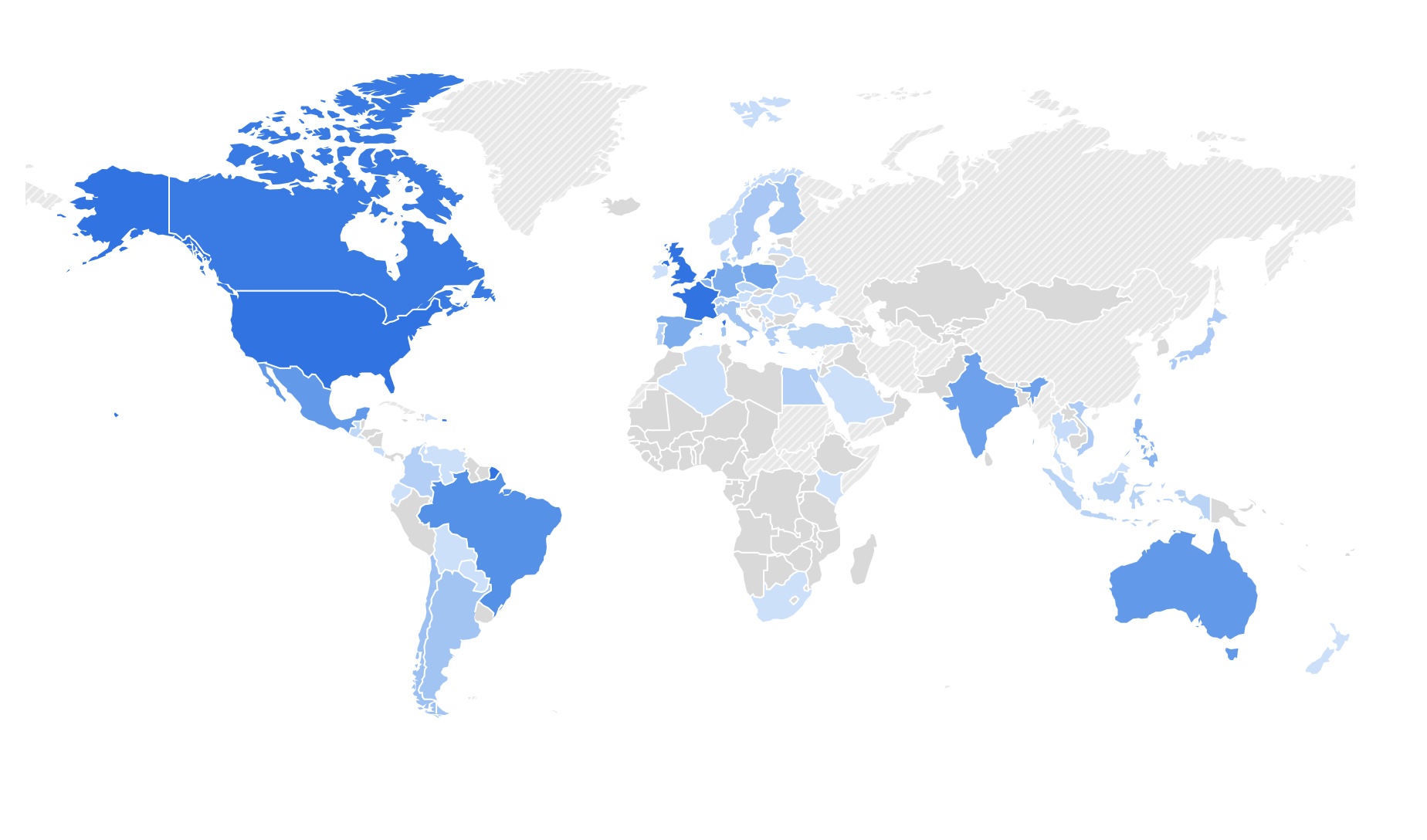
Global audience of an independant musician: map of my Spotify listeners (April 2024)
Today, ambient music creation is more active than ever... Dozens of musicians are creating new soundscapes, often demanding and experimental, and sometimes achieving international fame (Ólafur Arnalds, Max Richter, Nils Frahm...),
Film and series productions are multiplying the opportunities for trailers and soundtracks, and often the accompaniment of the image allows a certain experimentation in the music...
Numerous independent labels are springing up, offering visibility to emerging, confidential or already-recognized artists, with no concern for immediate commercial profitability. In addition to musical quality and innovation, these labels often add a high standard of design and packaging, giving a new life to the discographic object, in the form of a CD or e-record.
A platform like Bandcamp is a veritable marketplace for independent creation, forging lasting and equitable links between musicians and their audiences...
A whole ecosystem of enthusiasts and activists circulate this independent creation in the form of blog reviews, podcasts, radio shows and playlists.
Despite the opacity of their algorithms and their often derisory remuneration, streaming platforms are bringing independent creation to the four corners of the globe, from New Zealand to Canada, from Argentina to Japan....
Long, ambient, minimalist tracks for meditative immersion and intellectual focus (reading, writing...). Take the time to listen and unwind!
This playlist features Brian Eno, Laraaji, Gavin Bryars, Harold Budd, Alio Die, Andrew Heath, Ensemble Dedalus, David Sylvian, Jon Hassell, Hammock... and my music...
Feel free to listen and to like!
Thanks!


Before the drastic reduction in stream fees announced for 2024, Spotify's algorithms are kind enough to provide us with a review of the year (almost) gone by...
These figures testify to my audience, confidential but real, and in my eyes honorable, given that my music doesn't fit into the mainstream ambient boxes: too abstract, too dark, not melodic enough, no rhythm, a little too experimental, too atmospheric, and so on.
I see this as a major encouragement to continue on my path, without losing my soul, and remaining myself...
There is indeed an international public for music that's a little "different", that stands out from the standards of yoga and other relaxation music...
From South America to the Japanese archipelago, from the farthest reaches of Canada to Africa, from Northern Europe to Australia, there's a loyal, open-minded following for my creative journey...
Thanks to all my listeners and to the playlists curators who support my music and share my tracks!

Many thanks to Matt, at ELECTRONICA.ORG.UK, for this splendid review of my ambient track "Aurelia" !
Christian Wittman’s captivating track “Aurelia,” part of his album “Dreams and Drones,” invites listeners on a profound journey through atmospheric soundscapes inspired by the universe of French poet Gérard de Nerval. Delving into the realms of ambient and contemplative music, Wittman’s composition paints a vivid picture of misty and solitary landscapes, where introspection and imagination intertwine.
The track begins with a mesmerizing interplay of shifting chords, setting a contemplative and ambient backdrop. Evocative layers of strings and atmospheric sounds further enhance the mood, creating a meditative and dreamlike atmosphere that immerses the listener in a rich sonic tapestry. As “Aurelia” gracefully evolves, gentle melodic fragments emerge, gracefully drifting in and out of focus, akin to wisps of thoughts weaving their way through the mind.
As one of the founding members of the esteemed French group LIGHTWAVE, Christian Wittman brings years of expertise in the realms of electronic and ambient music. His compositions draw inspiration from an array of artists, including Brian Eno, Harold Budd, and Stars of the Lid, which shines through in his masterful fusion of ambient and chill-out elements.


